

Lewis and I were thrilled to go to Denmark. The United Nations' annual World Happiness Report listed it as the second-happiest place! The peninsula-nation is a superb place.
It is one of three Scandinavian nations, and they are all kingdoms: Denmark, Norway, and Sweden. It is also a Nordic nation. Nordic nations include those kingdoms, Finland, Greenland, the Faroe Island, and the island-nation of Iceland.
Since 1219, Denmark's flag, Dannebrog, includes the Nordic cross. It is the oldest flag in the world. Nowadays, all Nordic nations use the Nordic Cross in their flags, as do several North Sea countries. That is unique in the world where a region of sovereign nations share the same emblem to show solidarity.


We visited the kingdom's seaside capital: Copenhagen.


This is the city's coat of arms.

It is situated on Zealand Island, near the Jutland Peninsula. (The island-nation of New Zealand is not named after Denmark's island; it is named for the Zeeland Province in the Netherlands). The Danish seafaring city straddles the North Sea and the Baltic Sea.
We departed from our local airport in Queen County, NYC...

and jetted to the Kingdom of Denmark...

Our transatlantic flight was marvelous aboard Norwegian Air: a dependable, comfortable, and affordable airline with more legroom than its pricier competitors.


In the morning, our jet descended to its destination: a beautiful oceanside airport.


When stepping inside Copenhagen Airport, the first thing you notice is wood flooring. Classy and nice!


They use durable hardwoods like African padauk and Brazilian jatoba. The bright and airy terminals are heavenly: plenty of clean/automated restrooms, easy-to-read signs, and Information kiosks.


(T-mobile supplied me with unlimited texting and data at 2G speeds at no extra cost. The city's free WiFi did the rest).


The airport is patrolled by members of the Politi (Police). Unlike America's duplicitous levels of local, city, state, federal, highway, transit, and airport police, Denmark uses the popular model of a national police force. Unlike NYC cops who carry assault rifles at transit hubs, Danish constables rely on pepper spray and pistols. Last year, the nation only had 54 murders. We always felt safe in the city.

Next, we had to get to the central part of the capital.
Brainwashed from their "car culture", Americans may want to drive themselves everywhere... but cars are not needed. It is better to use the marvelous public transit and your own two feet.
Helpful attendants at the Information Desk issued our Copenhagen Cards, which we pre-purchased online. Learn about them here...

We used them for our subway ride (they call it the Metro) to our hotel. Yes, unlike New York City, their international airport is connected to the city by rail: train and subway. Seen below, Mercedes taxis are an option, but the Metro is more efficient... and it was included with our Cards.

Instead of fussing with turnstiles (as in NYC), riders "tap and go" at kiosks when they board and disembark from trains.


Instead of fussing with turnstiles (as in NYC), riders "tap and go" at kiosks when they board and disembark from trains.


Thrilled with the view, we sat in the first row by the big window! We were excited to finally see a clean subway system because this is what "expensive NYC" uses: dirty trains that are outdated from 1975. Despite being the wealthiest city in America, NYC's billion-dollar public transit system looks impoverished.


Here's a link to NYC subway pictures by the New York Times:
https://halfwindsorfullthrottle.blogspot.com/2018/12/scandalized-subways.html
Meanwhile, a smaller nation with less tax revenue built a vastly superior system... and the trains are fully automated!


Metro trains arrive every 4 minutes—precisely. So nice!


Entirely open, you can pass through different cars and see from one end to the other. Each train holds 300 people... and dozens of bicycles! They don't need longer trains because trains arrive so frequently.

They are unbelievably quiet! Watch this video to hear how loud NYC's electric subways are—especially at "posh" Fifth Avenue station, where rent is second-highest in the nation.
(Turn the sound on)...
It must be nice to live a decent place where things are they way they're supposed to be. We want that. As the train arrived at stations, everything happened peacefully. Riders were politely hushed (no pushing or shoving), the doors moved silently, and the train sped on punctually (no stalling or delays).

ALL STATIONS have ELEVATORS! Coming from America's dilapidation, that impressed us greatly.

(For comparison, in 2017, the NYC Comptroller published an audit that few of the MTA's elevators and escalators work. 80% of 65 elevators & escalators didn't receive necessary servicing during 18 months. They failed to get preventive servicing either (when they were supposed to be worked on—prior to breaking down). Repair-orders were not even created after problems were found! There's a class-action lawsuit against the MTA because less than 25% of the New York City's stations are handicap accessible. But NYC doesn't care).

The Metro took us past Amager Strandpark (Beach Park) serviced by three stations! (It must be great to reach the beach by subway). The 148-acre park has 3 miles of beachfront and a 1.5-mile manmade island.

Seen above is Middelgrunden. Built in 2000 as the world’s largest offshore wind turbine farm, it quietly gives Copenhagen affordable electricity that is renewable. We don't have that in NYC, due to America's greedy industries for coal and oil. (In the 1970s, 20% of Denmark's energy came from coal, but the 1973 Oil Crisis made them rethink their strategy, so they immediately transitioned to wind turbines, biomass, and gas. Meanwhile, a lot of America's energy still comes from coal.
We exited at the solar-powered Nørreport Station.

It progressed a lot since its creation, 100 years ago.

Skylit with clean stainless steel, the escalators carried us 2 levels to the street.

It progressed a lot since its creation, 100 years ago.

Skylit with clean stainless steel, the escalators carried us 2 levels to the street.


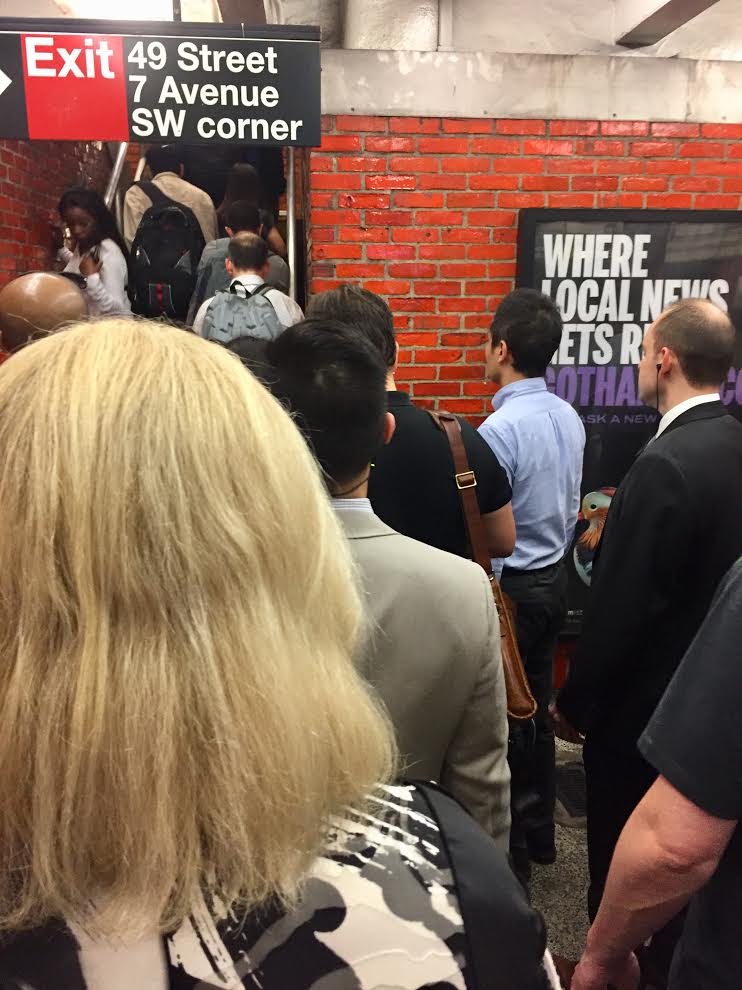
That's a big difference from what we experience in Manhattan!


Aboveground, we stood on North Rampart Street.

In the 1600s, it was the city's Fortification Wall.

The city wall was disassembled in 1867. In 1913, the Metro route was installed.

We saw parking lots for hundreds of bikes. Solar-powered light posts (seen below) stand by each parking spot, marking them at night as available or not.


Lewis and I admired the kiosks that sold coffee and drinks with old-world style.

Originally public telephone kiosks, the turn-of-the-century structures give free Wi-Fi and have accurate clocks!


Originally public telephone kiosks, the turn-of-the-century structures give free Wi-Fi and have accurate clocks!


Lewis paused in Danske Bank for a currency exchange. The kingdom is part of the European Union, yet it retains its own currency and doesn't use Euros. Instead of standing in queues waiting for the next teller, customers get a numbered ticket and wait comfortably on seats. Within moments, a teller gave us Danish krone (crowns): paper and coins with the Queen's image on them.


Next, we peeked inside Sankt Petri Kirke (St. Peter's Church) in the city's Latin Quarter. It is Copenhagen's oldest church, dating from the mid-1400s... before Columbus reached America. It is blend of Gothic, Baroque and Rococo style.


Our hotel was on the corner of Vendersgade, named for the King of the Wends. Part of the Danish monarchial title since 1182, "King of the Wends" signifies Denmark's governance of Wendish people.

Named after a famous poet, Ibsens Hotel looked just like its Facebook images. Neon signs and a flag on its tower made it easy to spot. Operated by Arthur Hotels Group, it is connected with its sister-hotel, King Arthur Hotel.


This year, Tripadvisors.com ranked it #13 in the city—up from #24 last year.

The Front Desk staff was charming, smiley and helpful. In Danish, Lewis' name is "Ludvig". My named doesn't translate, so it remained as Kenneth (it originated with ancient Gaels to mean "handsome lord born of fire").


Day-and-night, candles and vases of flowers adorned every corner. In the lounge, a gas fireplace was always on to provide ambiance.


A complimentary bowl of apples and a water pitcher (with reusable glasses) was always filled. The vibe exuded Nordic sleekness.


The rear courtyard was a cozy: sunlit flowers and lantern-lit tables under umbrellas.


In the Danish language, coziness fosters a sensation called hygge (pronounced "hoo-guh"). In Scandinavian culture, feelings of wellness and contentment are priorities. Life/Work Balance must be achieved. That explains why Denmark rates highly on the World Happiness Index... and why Americans are fatigued from overworked jobs and a greedily "for-profit" healthcare system.


Lewis and I were delighted with our hotel's spa, bars, and sleek Italian restaurant. The staff was smiley and sociable.


Emailing the hotel manager, Carina, I arranged for those chocolates to be added to our room. Organically sourced from far-flung farms that still cultivate heritage cacao trees, they're made by a Dutch chocolatier, Original Beans. Former pastry chef at Geranium (Copenhagen's Michelin 3-star restaurant), Mark Herman imports them to Denmark. He supplies Ibsens with catering, so Carina got us chocolates from Ecuador 42% cacao, East Congo 55%, Bolivia 66%, and Mexico 88%. She only charged us for the chocolate, not the delivery. So sweet!
Another cute note was left under the bed, in true Danish cleanliness style...

Related to Scandinavian cleanliness, the hotel provided slippers because Danes consider it unhygienic and impolite to keep your shoes on when entering a home or hotel room. Lewis and I already do that (because NYC is filthy), yet most Americans scoff at the idea. Ignorantly, they keep their shoes and sneakers on at home, spreading dirt and bacteria all over their home, including their sofas, furniture, and beds. That's crazy!

Our queen-sized room had five modern windows, which we opened for breezes.


Our view was the inner courtyard, instead of street noise. :-)


Going downstairs, we followed the signs into the King Arthur Hotel, built in 1882.


In this video, the front doors are antique but automated...


We sat in the bar to enjoy Live Jazz. Every evening from 5-6pm is Cozy Hour, and the hotels offer every guest a complimentary glass of beer or wine.

A faux fireplace emitted wisps of smoke.


After our free wine, we purchased cocktails. I got an aquavit made by Copenhagen Distillery, and Lewis got a Pisco Sour. Saying "Cheers" in Danish is Skål!

Then, we tried a locally-made botanical gin.

Our young bartender, Peter, was a native Dane studying to be an environmental engineer. He told us that education is free in Denmark (and for students coming from the European Union or with resident visas). The government subsidizes students with $900 monthly payments, and students get discounted fares on public transportation. AMAZING!
Being friendly, Peter described the affordable "food scene", supermarkets, and culture in Copenhagen. All of his expenses cost 1,500 crowns, per month. In New York, that's merely my rent! His rent and utilities are 800 crowns, per month, and he lives alone. (In NYC, expensive rent compels people to live with one or two roommates). A monthly pass for public transportation is 60 crowns... whereas my monthly subway costs $130 for the crappiest system in the world.


In my video, Marie Mørch sang in English, accompanied by piano (turn the sound on)...
Next, we explored the hotel's gym and its zenful spa.


We relaxed before our 9:30pm dinner reservation. The highly-acclaimed restaurant was only two blocks from our hotel.
In Part 2, follow us to that restaurant.

Oh my god! I love how public spaces look so clean! And the hotel looks gorgeous!
ReplyDeleteNice blog! Please read our travel blog on Machu Picchu. I'm sure you will love this town of Inca civilization & also a mighty travel destination among travelers.
ReplyDelete