

In French Renaissance opulence, the department store fills the entire street. Magasin sustains 98 stores throughout the kingdom.


As a souvenir for his coworkers, Lewis bought a box of gourmet chocolates by Anthon Berg, holders of a Royal Warrant. In a kingdom, a Royal Warrant signifies that the brand is so good that the Royal Household uses them and awards the Warrant to inform everyone. Administered by the Marshal of the Court and his Secretariat, warrants in Denmark must be renewed after five years, and they permit brands to use a crown above their logos. Brands crave recognition as a Royal Court Supplier! Proudly, Anthon Berg is one of 18 companies that still use the historic predicate: Supplier to the Royal Danish Court.

Magasin Du Nord was also bestowed with the status of a royal supplier. Here are other honored companies...


Nobody was at the cash register, so Lewis approached an area selling wine, and the nice cashier gladly rang up the purchase, even though it wasn't his department or product. The man even gave us a gift bag and answered Lewis' questions about the chocolates. Great service!


Ascending the store's levels via glass-enclosed elevators, Lewis shopped for another dress to give his mother. Finding the perfect one, he signaled a salesgirl to discuss size conversion. The bright-eyed woman cheerfully took out her iPhone to do calculations. Embarrassed that he hadn't thought of that himself, Lewis apologized, yet she politely assured, "No problem. That's what I'm here for." Then, she packaged the dress as a gift and bagged it. She refunded the VAT tax (since we don't yet live in the Europe), so we wouldn't have to do that at the airport.
The store is friendly to outsiders, giving 10% to foreigners and supplying them with City Guides.


At the top level, restaurants have views of the cityscape.


We bought a rhubarb drink, made from sustainable organic ingredients. Its company presses and sorts the fruit manually. They avoid too much automation to ensure that unskilled laborers can have employment.
The waiter suggested trying world-famous Carlsberg beer, locally made in Copenhagen since 1847, and also a holder of a Royal Warrant.


All counters have electric outlets for customers' devices.
The waiter suggested trying world-famous Carlsberg beer, locally made in Copenhagen since 1847, and also a holder of a Royal Warrant.

Founded by Jacob Jacobsen—and named after his son, Carl—their laboratory identified the yeast needed to make pale lager, yet it shared it freely with the world. The lab’s director trained an entire generation of protein scientists. Like Charles Dickens’ character, Fezziwig (or Mr. Steinway of the piano factory-town in Astoria), Jacobsen’s workplace was full of creativity, fun, and happy spirited camaraderie: wonderful Christmas parties, trips to Tivoli amusement park, musical story-telling, and summer picnics. His brewery is handsome, whimsical, and amazingly ornate. He donated his art collection to the National Museum. He paid for statuary in city parks. When Frederiksborg Palace burned down, he funded its rebuilding, and his Foundation operates it. Without discrimination—common in the Edwardian era—he employed women like Kirstine Smith, who earned scholarly degrees in mathematics and physics. Carlsberg brews 500 beers, including Russia’s best-selling Baltika. It owns breweries in Latvia, Poland, Sweden, Switzerland, Italy, Germany, Portugal, France, Russia, the United Kingdom, Ukraine, Kazakhstan, China, Malaysia, Myanmar, India, and Israel. Only the United States has tariffs to prevent competition against U.S. brewers.

All counters have electric outlets for customers' devices.

Everything was clean!

A pop-up location for Hotel Chocolate was there—saving us a trip to their store later.

Down the street is Hotel D'Angleterre. The hotel was founded in 1755 as one of the first deluxe hotels in the world!


Lewis visited overseas colleagues at the Chanel boutique. Joan was a sales associate born in Bermuda who moved to Copenhagen 20 years ago. She doesn't miss the Caribbean heat, and being a citizen of a British Overseas Territory gives access to the United Kingdom. She loves Copenhagen Fashion Week and easy access to other places in Europe.
From there, we sauntered along Europe's longest pedestrian shopping street: Stroget.


We encountered many lovely shops, including two not found at home: H&M Home and Zara Home. While their stores in America operated as "bargains", these were high-end but with fair prices! It seems that companies have a more polished appearance in Europe and Asia. No wonder those populations have stylish homes without marked-up prices. H&M had a florist, too!


Our favorite was Arket, full of quality clothes in trendy styles amidst an airy environment. A coffeeshop allowed parents to rest with children while their spouse did shopping. Employees were attentive and helpful, using radios to have inventory brought up to customers.


Lewis bought a summery dress for his friend, and I got a cranberry-colored sweater. It's quite soft. The cashiers moved quickly, giving us free hand moisturizer samples while we waited.
From there, we went to the island of Slotsholmen: home to the Danish Government.

One of its bridges, Stormbroen (seen below), means Assault Bridge. It earned its name after the 1659 Assault on Copenhagen, where Danes defeated a treaty-breaking attack by Swedish troops. Workmen, students, and civilians stood alongside their soldiers. They lost 17, while the Swedes lost 1,000. Enjoying mercantile success with Denmark, a Dutch fleet rescued the city, ending a six-month Swedish naval blockade, and the current international Nordic borders were established.

We visited Christianborg Palace, housing the Prime Minister's office, Supreme Court, and Parliament.

Denmark has several political parties so none get too powerful.

One of its bridges, Stormbroen (seen below), means Assault Bridge. It earned its name after the 1659 Assault on Copenhagen, where Danes defeated a treaty-breaking attack by Swedish troops. Workmen, students, and civilians stood alongside their soldiers. They lost 17, while the Swedes lost 1,000. Enjoying mercantile success with Denmark, a Dutch fleet rescued the city, ending a six-month Swedish naval blockade, and the current international Nordic borders were established.

We visited Christianborg Palace, housing the Prime Minister's office, Supreme Court, and Parliament.

Denmark has several political parties so none get too powerful.

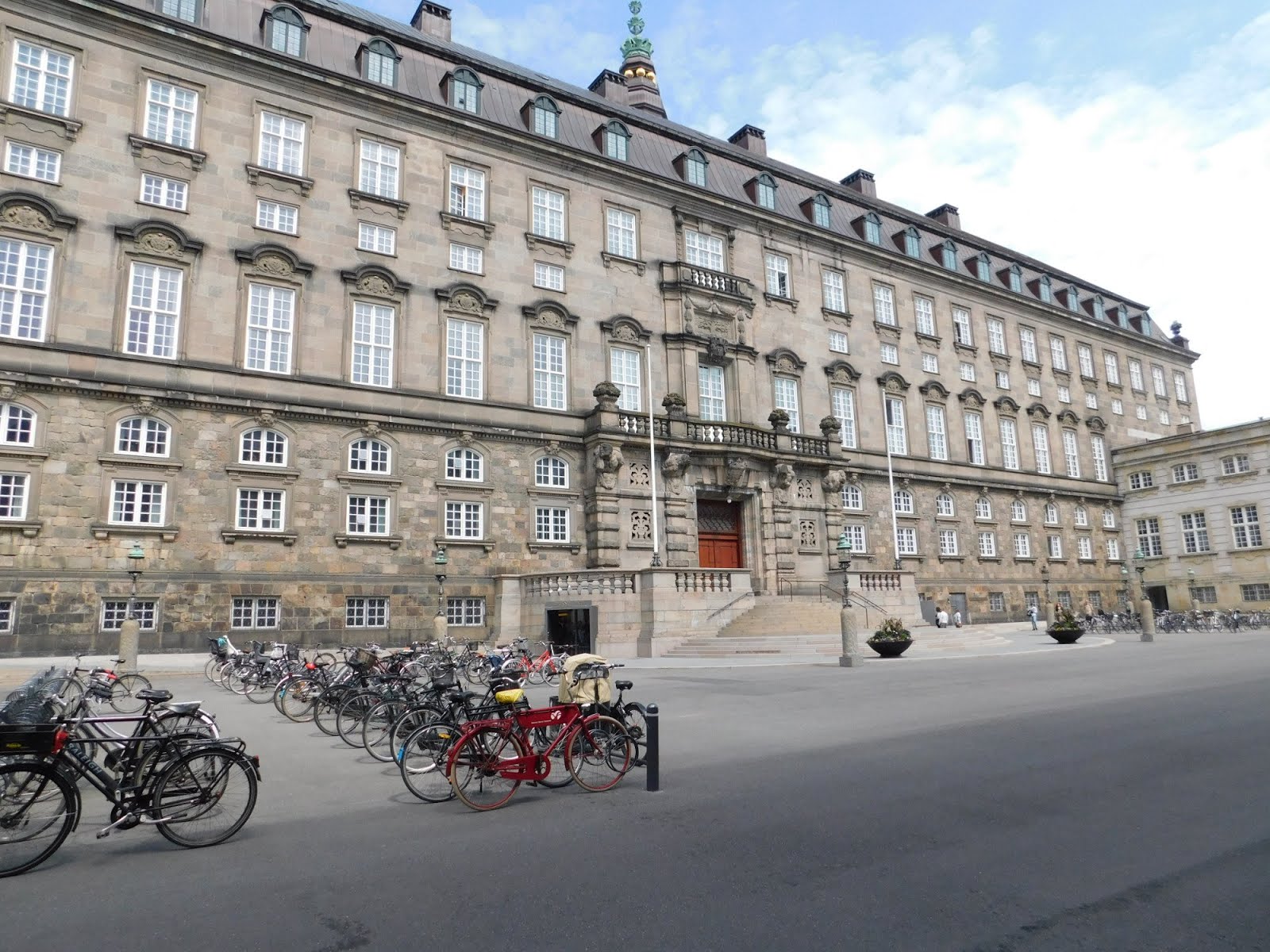
It is a mammoth building.

It was the site of a royal affair between the wife of mentally-ill King Christian VII and his doctor, Johann Friedrich Struensee (illustrated below). In 2012, Lewis and I enjoyed the film about it: A Royal Affair.

Walking over Marble Bridge...


Walking over Marble Bridge...


...we approached the gatehouse and saw ministers arrive (cars remotely lowered stanchions in the driveway), while others rode bicycles to work ("leading by example"). Free to anyone, the tower offers the highest views of the city (at 106 meters). A restaurant in the tower serves lunch, teatime, and dinner.


The equestrian statue of King Christian IX was made by Anne Marie Carl-Nielsen, in 1927, at the age of 63! In 1891, she was a founder of Denmark's oldest artist association. So great was her energy that Vincent van Gogh travelled there to display his works next to hers. As a trailblazer, she created a Society for Women Artists in 1916... and she still raised a family!


Lewis posed handsomely in a guard booth. Its roof is emblazoned with the Royal Monogram of the Queen.


Near the forecourt is a Horse Riding arena. Christianborg was the royal residence from the 1400s until a fire in 1794. It is still the historic site of the Royal Stables, which were installed in 1745. The horses are exercised in the arena regularly.


A pair of charming constables smiled at us, as we found the entrance to the stables.


The interior was tidy and handsome.

The horses were, too!
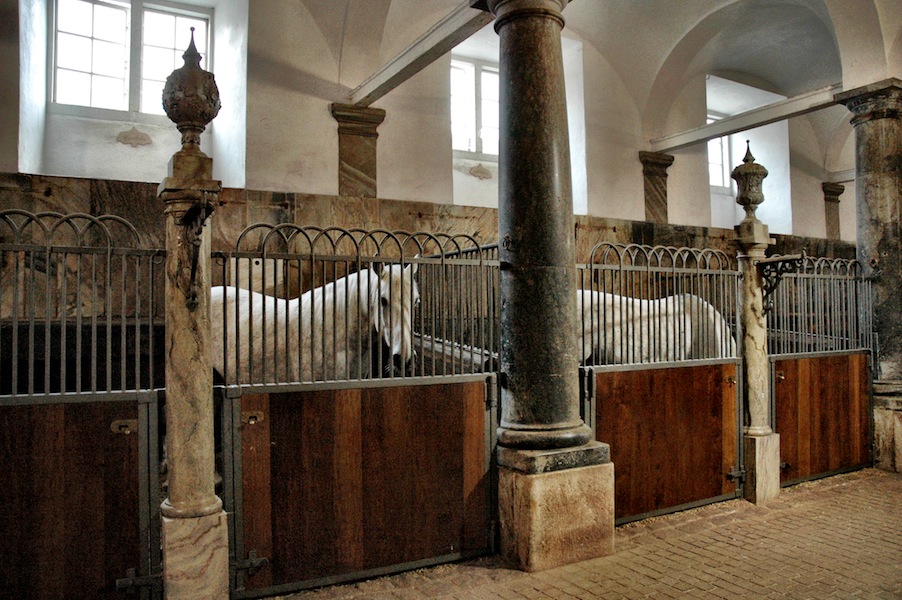
In 1994, the white horses came from the Czech Republic, at the request of the Queen's husband. Called Kladrubers, they are smart gentle animals, used to draw aristocratic coaches for centuries. Born with dark hair, their follicles mature into white hair.
*To see our first trip the Czech Republic, please use this link: https://halfwindsorfullthrottle.blogspot.com/2024/04/our-trip-to-prague-czechia-part-1-of-9.html


Most of the 16 horses investigated us, but others aimed their backsides—which there was plenty of...


...a nice result of all that cycling!
A horse named Cordoba really liked Lewis (who is a horse sign in the Chinese zodiac). All animals love us!


We wish the Central Park horses were treated humanely. *To see how NYC allows them to be treated, please use this link:
We admired the saddles, carriages, and coaches.


It is an impressive assortment of heritage, and the Danish government maintains those antiques beautifully. The royal family uses them often.


A highlight was the Golden Coach, which was handmade in Copenhagen by Henry Fife in 1839. As a coupé, it holds two passengers. Its exterior is plated with 24-carat gold leaf! Gilded crowns adorn it everywhere. Last year, the metal crowns were redone by Georg Jensen Silversmith, a company that earned a Royal Warrant.


Queen Margrethe II rides through Copenhagen in it during New Year's Day, and she uses it during State Visits and Jubilees.


*To see when we admired another Golden Coach at a Royal Stable in London, please use this link:
Across the Frederiksholm Canal is the huge National Museum, which was free with our Copenhagen Cards.

_(36267234721).jpg)


In 1743, the building was the Prince's Palace, but the prince shared it with artists and explorers for the betterment of society.


Walking west, we discovered the Ny Carlsberg Glyptotek!


It is a wonderful sculpture museum. We got free admission with our Copenhagen Cards and stored our bags in lockers.


Built by brewer, Carl Jacobsen, this magnificent place opened in 1897. He added the glass-domed Palm Tree Garden in 1906, and its café is a sunny spot.


A highlight: seeing Edgar Degas’ "Little Dancer of 14 Years"!

We saw ancient Mediterranean cultures, modernist works, Danish Golden Age paintings, and French Impressionists.


We popped into Conditori La Glace for exceptional chocolates


The bells of Copenhagen Cathedral tolled and told us the time of day. Completed in 1209, it was destroyed by fire in 1314. Rebuilt, it was looted during the Protestant Reformation (which caused the 1535 Siege on Copenhagen); in hatred of Catholic corruption, its gold/jeweled altars were dismantled. 40 years later, lighting struck and destroyed the tower and roof. Its replacement was consumed by flames in the city's Great Fire of 1728. Accurately rebuilt, the church was destroyed by the British during their 1807 attack on the city. Unmistakable, the shiny spire was targeted by British cannons—firing incendiary rockets—until the heat from the fires caused the copper roof to melt, and the 42 bells in the tower collapsed! Its final rebuilding was based on the original medieval design. Amongst its four donated bells is the oldest one in Denmark, cast in 1490.


We crossed Ørstedsparken. The park has a variety of trees, including an ancient species of Ginkgo Biloba from China.


We crossed Ørstedsparken. The park has a variety of trees, including an ancient species of Ginkgo Biloba from China.


As seen above, that park connects to Israel Park, named for the Jews who were saved by Denmark during WWII. [October 1, 1943: Adolf Hitler ordered Danish Jews to be arrested and deported. King Christian X flatly refused, and the Danish Resistance Movement—with the assistance of Danes of all walks of life—evacuated 7,220 of Denmark's 7,800 Jews (plus 686 non-Jewish spouses) by sea to the neutral Kingdom of Sweden. The rescue allowed Denmark's Jewish population to avoid capture by the Nazis, and it is considered one of the largest actions of collective resistance. Danes also orchestrated a rescue operation called The White Buses, for imprisoned Jews. They partnered with Sweden and the Red Cross to evacuate thousands of Jews in hospital buses that didn't go to hospitals but delivered them safely to Sweden].

The King often defied the Nazis who occupied his country, and that endeared him closer to this people.

The King often defied the Nazis who occupied his country, and that endeared him closer to this people.

Another indication of excellent infrastructure, the park cleverly conceals a 3-level underground parking lot.


Aboveground are playgrounds, water features, basketball courts, and skateboard courts, and it's illuminated at night.


Aboveground are playgrounds, water features, basketball courts, and skateboard courts, and it's illuminated at night.


Inside the bustling Food Hall, we went to the Tapas Bar.

We also invested $43 in foie gras from Ma Poule, who import everything from France.

America's Food Drug Administration blocks such foreign foods from being sold in America, due to their organic methods. Meanwhile, the FDA blindly allows chemicals and unhealthy ingredients to go into mass-produced food (resulting is massive "recalls", each month), as indicated in this link:
https://halfwindsorfullthrottle.blogspot.com/2018/12/your-health-well-being-are-unimportant.html
From a bakery, we got a baguette, which the girl sliced for us... and she helped Lewis count the correct coinage (to use it up before we left the country).


We got gelato to enjoy al fresco.

It was hugely better than the phony Haagen-Dazs from America, started by a guy in NYC who invented the name to deceive customers who wanted "Old World" quality. In 1983, he sold the brand to Pillsbury: conglomerate notorious for low-quality Americanized junk-food. Now, it's inundated with bleached sugar, innutritious corn syrup, whitened skim milk, sweetened condensed milk, oils, soy lecithin (an additive emulsifier and preservative for "shelf life" that is made using bleach), and cocoa processed with alkali. Yuck!
We returned to our hotel in time to enjoy complimentary wine from Cozy Hour, which just ended.

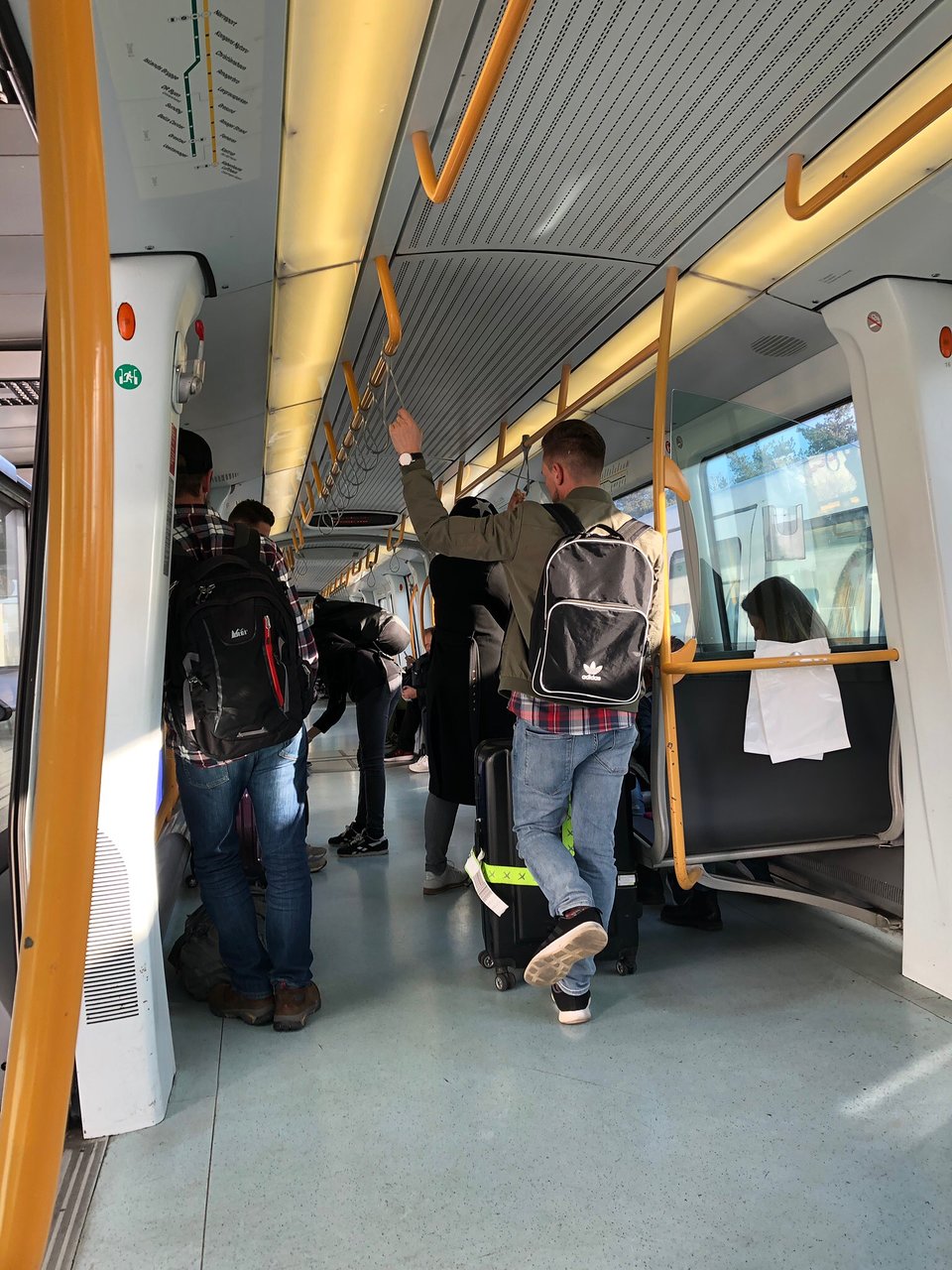
In America, you must leave home extra early to avoid traffic and railroad delays. Yet, for our departure in Denmark, the Metro sped us efficiently to the airport.
You might expect long lines at badly-run airports and Security Checkpoints (pictured below in America).

Not in Denmark! :-)
Statistically, Copenhagen has the most efficient security clearances in Europe! A time-clock lets you know how long the queue might be at the Security Check. Ours was under four minutes. For Americans like us, it seemed miraculous! We were elated by a simple thing like efficiency.


Their self-check-in kiosks are plentiful, and my app for Norwegian Air confirmed our accommodations aboard their new Dreamliners (60% larger windows with electronic dimmers, and the most legroom I ever had).

Condé Nast rated Copenhagen's airport as the 7th best international airport in the world, and it won Best Security Processing in the world by the Skytrax Survey. It won "The Most Efficient Airport in Europe" for 10 years in a row!


Vogue magazine said it has the best airport shopping! Employees were gracious and gregarious to answer all our questions.


I heard a man exclaim, "Wow, this is now my favorite airport in the world!" I agree.


Notice the easy-to-read clocks and Departures screens at every eatery, so you don't have to worry during your meal.


(JFK Airport lacks clocks in its departure terminal... something all other countries seem to know how to do).
You can get a haircut in the airport. You can have meetings in conference rooms. A Japanese eatery had trendy conveyer belts of food. The city's best organic bakery and coffeehouse was there.


Back in New York City, unchanged problems plagued our local subway station (reopened after a 6-month renovation, yet continuously closed for more work). Ticket machines didn't work, and a huge delay existed between (overpaid) manually-operated trains.


I brought a tin of Danish butter-cookies to my coworkers, and they devoured them. Made in Denmark, their buttery goodness was delicious. True to Danish values, there were no fillers, additives, preservatives, or artificial colors/flavors.

A skeptic (who thinks America is better than everywhere else) said that it was ridiculous to need cookies from Denmark. Trying to prove his point, he went to a nearby store and bought a similar-looking tin that claimed to have Danish cookies. It mimicked the Danish company with a tin of similar color/shape: an attempt to falsely lure unwitting buyers.


Everybody complained about their taste. The cookies were made in India!

The ingredients were disgusting: vegetable oil, dry milk, artificial butter, glucose syrup. When I considered what type of greedy/cheap company would try to make a product so cheaply via underpaid workers with innutritious ingredients, I knew that it would be an American company. It was. A large USA company insists on being crappy, while a smaller one in Denmark behaves authentically.
*To see the food products that are abundant in the USA, please use this link:
https://halfwindsorfullthrottle.blogspot.com/2018/12/your-health-well-being-are-unimportant.htmlWe can't wait to visit more societies that take care of people and uphold "quality of life"... how life should be.

I was so inspired by Danish culture that it became the setting of my third adventure novel. To learn about my book, please use this link:
Since posting this in my blog, 5 friends read it and booked their next vacations to Copenhagen—flying on Norwegian Air and staying at Ibsens Hotel! My hair stylist also forwarded these blog entries to one of his clients for her trip there.

To see the next time that we visited a Nordic nation, please click this link:

No comments:
Post a Comment
Don't be shy: leave your comments :)